Tales from our Adventure
To read Part 1, see the previous post.
Before the trip even started, I encountered a significant hiccup. Because our first location was Cusco, Peru (11,000+ feet), we were instructed (in Washington, DC) to take the elevation medication we were told to bring. After the welcome dinner and reception in DC, Michael and I took our first dose of Acetazolamide (Diamox). An already early morning wake-up of 3:30 am got even earlier when my body woke me up at 1:00 am with a violent reaction to the medication. Both ends, as it were. After several trips to the bathroom, I gently woke Michael and said, “I think I might be sick.” He let out a slow expletive. We were pretty scared that this once-in-a-lifetime trip might end before it began. I was pale and shaking, running to the bathroom every few minutes. Michael found Dr. Blake (the expedition physician traveling with us) and asked him to come to our room. Dr. Blake quickly surmised I was experiencing a reaction to the altitude medication, and it was not food poisoning or the flu. He gave me Zofran (anti-nausea), a different altitude medication, and Liquid IV (hydration and electrolytes).

I was pretty weak, but I could feel my body was done once everything was out. Dressing, braiding my hair, and getting organized to leave took most of my remaining energy. Not feeling at all myself, we were out the door, boarding the bus at 6 am to take our group to Atlantic Aviation, an FBO (Fixed Base Operator) we would fly out of.
Seeing our National Geographic jet for the first time was pretty amazing, even in my weakened state. However, I cringe at the photos our Expedition Leader took of us just before boarding. Once on board, we were greeted by tall, tan, blonde-haired, blue-eyed Amazon Icelandair flight staff. I felt (and looked) like an absolute ogre! I didn’t partake in the Champagne welcome beverage or any of the food served on the 8-hour flight to Peru. They knew I was recovering from being ill, and the flight staff did their best to look after me. Part of the first meal for everyone but me was a lovely Caviar appetizer. I drank ginger ale, and they served me warmed blinis and crackers with butter and sea salt on top. The salted butter actually tasted quite good to me. The fattiness of the butter enhanced by the salt on warm bland blinis didn’t piss my stomach off, for which I was thankful. For several days after, I was on high alert. Nervous that another bout of illness could strike. But as the days passed without incident, I began to relax and enjoy the trip.
A lovely surprise was our “cabin bag”. In the overhead bin above our seats were two new Tumi duffel bags, one for each of us. These bags included a Tumi DOP kit with tissues, hand sanitizer, lip balm, compression socks, mints, and other small necessities. The duffel also included National Geographic (NG) slippers for the plane, an NG blanket, an NG poncho, and a hat. We were to leave these bags on the jet, and as we got souvenirs, we could put them in the duffel to not weigh down our luggage. In addition, at each location, there was a small local gift waiting for us and about $10 in local currency on our hotel bed, along with the daily/location schedule.
Tidbits & Stories
Peru
Peru’s tourism limits the number of people who can visit Machu Picchu daily. In contrast, India’s tourism does not limit the number of people who can visit the Taj Mahal daily.
Easter Island (Rapa Nui)
We think we saw John Malkovich at our hotel. We were told that a film was being shot on the island and several actors stayed at our hotel.
Sirolimus, also known as rapamycin and sold under the brand name Rapamune among others, is a macrolide compound that is used to coat coronary stents, prevent organ transplant rejection, and other medical uses.
It has immunosuppressant functions in humans and is especially useful in preventing the rejection of kidney transplants.
Rapamycin comes from a sample taken from Easter Island.
Source – Wikipedia
Australia
After snorkeling in the Great Barrier Reef, we had a lecture later in the day by a local toxicology expert. He informed us that Australia has the greatest number of lethal bugs, plants, spiders, snakes, birds, jellyfish, and other things that want to kill you.
Cambodia
Ta Prohm is known as the “Tomb Raider Temple” (from the film Lara Croft: Tomb Raider, 2001, starring Angelina Jolie). We visited this site and saw the trees growing in and around the stone temple.
Kathmandu, Nepal
For the limited time we were there (less than 24 hours), this city left a “deer in the headlights” impression. Known as the gateway to Mt. Everest, our expedition leader called Kathmandu “chaos on steroids”. There are 845,767 inhabitants as of the 2021 Nepal census. Our hotel (Dwarika’s) was a slice of calm in the city’s otherwise fast and hectic pace.
Paro, Bhutan
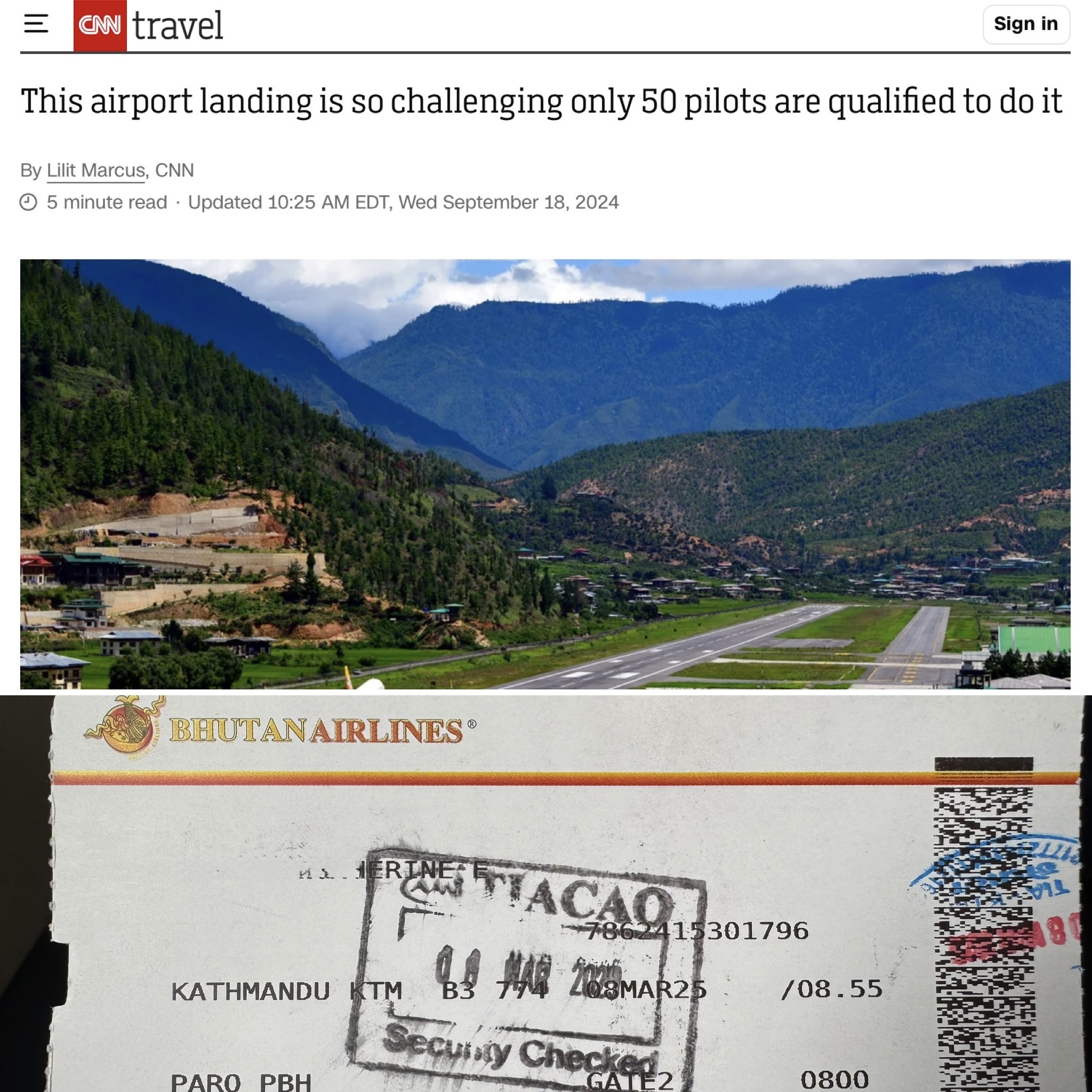
We flew into Bhutan’s Paro International Airport (PBH) on a local chartered flight. PBH is frequently featured on lists of the world’s most dangerous airports. Only specially certified pilots can make the manual, by-daylight-only approach between 18,000-foot peaks, through a long, winding valley, and onto a runway only 7,431 feet long and visible only moments before landing.
Firstly, there is no radar to guide planes into the airport. As a result, the pilot needs to fly entirely in manual mode. These specify at which speed and altitude the aircraft needs to be at specific visual landmark checkpoints as the pilots make their approach into Paro.
As if being able to check the visual landmarks and the runway wasn’t enough, the pilot also needs to watch out for electrical poles and house roofs on the hillside as they maneuver between the mountains at a 45-degree angle before dropping quickly onto the runway.
*Source: Simple Flying
Tiger’s Nest, Bhutan
Paro Taktsang, also known as the Taktsang Palphug Monastery, is perched on the side of a cliff in the upper Paro valley. The monastery’s elevation is 10,240 feet. Visitors hike just under 3 miles up, gaining over 1,700 feet in elevation.
In April 1998, the site burned down due to an electrical fire or a burning butter lamp. It was rebuilt. There is little information on the challenges of rebuilding. A Google search will reveal photos of the monument, and you quickly surmise that nothing short of magic would make rebuilding possible.
Agra, India
We landed at a military base in Agra, India (another benefit of being with NG).
There was a stark contrast between the scene driving to our hotel and within the hotel’s gated complex. This large disparity was hard for me to process. The best way I can describe it is – the haves and the have-nots. This was also noticeable at other locations on the trip, but India seemed to hit me harder than the previous locations. Ultimately, I realized all I could do was be a gracious guest. Say please and thank you . . . a lot. Smile. Tip. Don’t expect things to be as they are in the US. Go with the flow. Lean into the discomfort and learn from it. I realized I was there to learn and experience both the yin and the yang. The delightful and the less savory. This is travel.
Tanzania
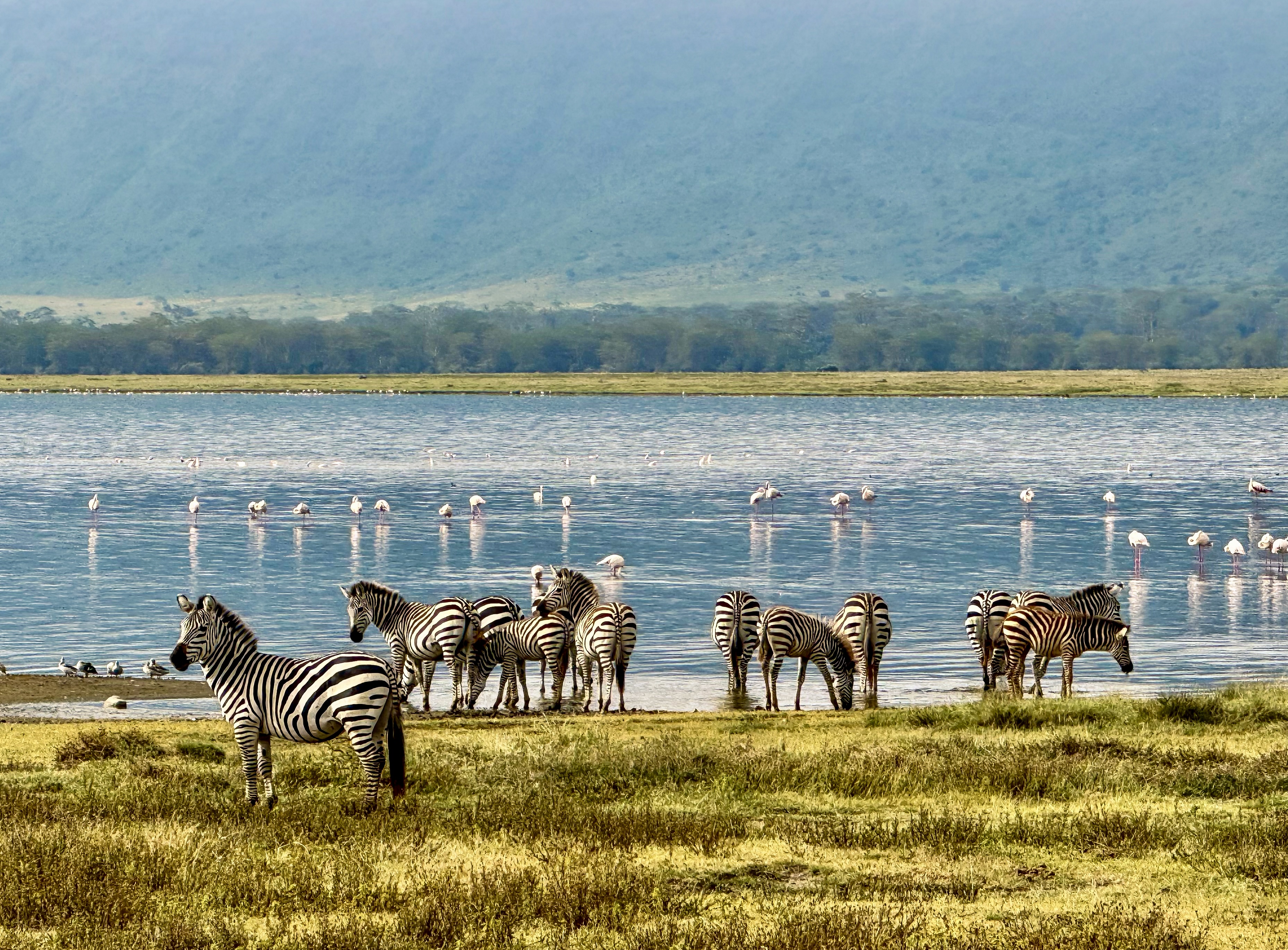
According to David Scott, a geographer and one of the NG Experts traveling with us, the Ngorongoro Crater is technically a caldera.
The staff at our hotel, the Melia Collection Ngorongoro Lodge, was so excellent. The following is one of two enduring stories from breakfast. Our first morning, we sat down to breakfast. A basket to toast, another basket of pastries, and a plate of fresh fruit were brought to the table. Our beverage order was taken. We then realized we should order off the menu and that the items on the table were just breakfast starters. When ordering our entrée, I asked if I could only receive one of the two Eggs Benedict, as I was not all that hungry, and I didn’t want to be wasteful. “Oh, yes”, the waiter said with a smile. When my plate came, it had the traditional two Eggs Benedict. I looked up at the waiter, and he said, “The Chef knows you have a big day of being on safari ahead of you, and you need your strength.” I smiled and said, “Thank you!”
Jordan & Morocco
Our final countries, Jordan and Morocco, are Arabic-speaking countries. Morocco also speaks French. From our trip to Egypt in 2023, I did my best to learn a few key phrases in Arabic. A few different times on this trip, our male guides would greet us in Arabic. I would reply with the typical response in Arabic. This would immediately catch their attention, and I would be asked if I spoke Arabic. I would smile and say no, only one or two phrases. This small act, however, impressed them. The effort is noted and greatly appreciated, even if you butcher a language.
Our travel days looked something like this –
We’d usually arrive at a new location during the day or late afternoon (we didn’t fly at night). The assistant expedition leader would proceed our group through customs and immigration and instruct us if any of the information we got before landing had changed, i.e., what documents to have ready or what questions we might be asked (sometimes it did change).
From the second we were in the airport, National Geographic Expeditions (NGE) advanced staff held signs guiding us where to go. As I’ve mentioned, we never handled our bags, except once on Easter Island, where they needed to check that we had no organic material. Once through the airport, we’d be bussed via lovely coaches to our hotel. A local NGE guide would join us on the bus. They would immediately start to educate us on the area and answer any questions we might have. Once at the hotel, an NGE desk was set up in the lobby, where a staff member was waiting for us to hand out room keys and answer any questions we might have. Usually, there was a lovely hotel welcome; sometimes, local dancers or hotel staff put local necklaces on you, or in Kathmandu, we received the red Bindi forehead dot. They’d also hand us a refreshing hand towel and a welcome drink. In our room, there would be a printed schedule, postcards, a local gift with a printed description, and $10 in local currency, usually in a lovely local coin purse.
Once in our hotel room, we’d usually have an hour or two to settle in before a cocktail reception and usually a lecture by a local expert, followed by dinner. Off to sleep and wake up to the day’s adventures. Breakfast was usually (not always) a buffet and or with made-to-order items. Perhaps the dreaded breakfast service is universal for restaurant staff. Except for Tanzania, I don’t remember many smiles from the breakfast staff. Even when I smiled at them and did my best to greet them and say thank you in their language. Or perhaps they had served too many Americans, and a morning greeting or thank you didn’t come close to atoning for our cultural and travel sins. However, I did my best.
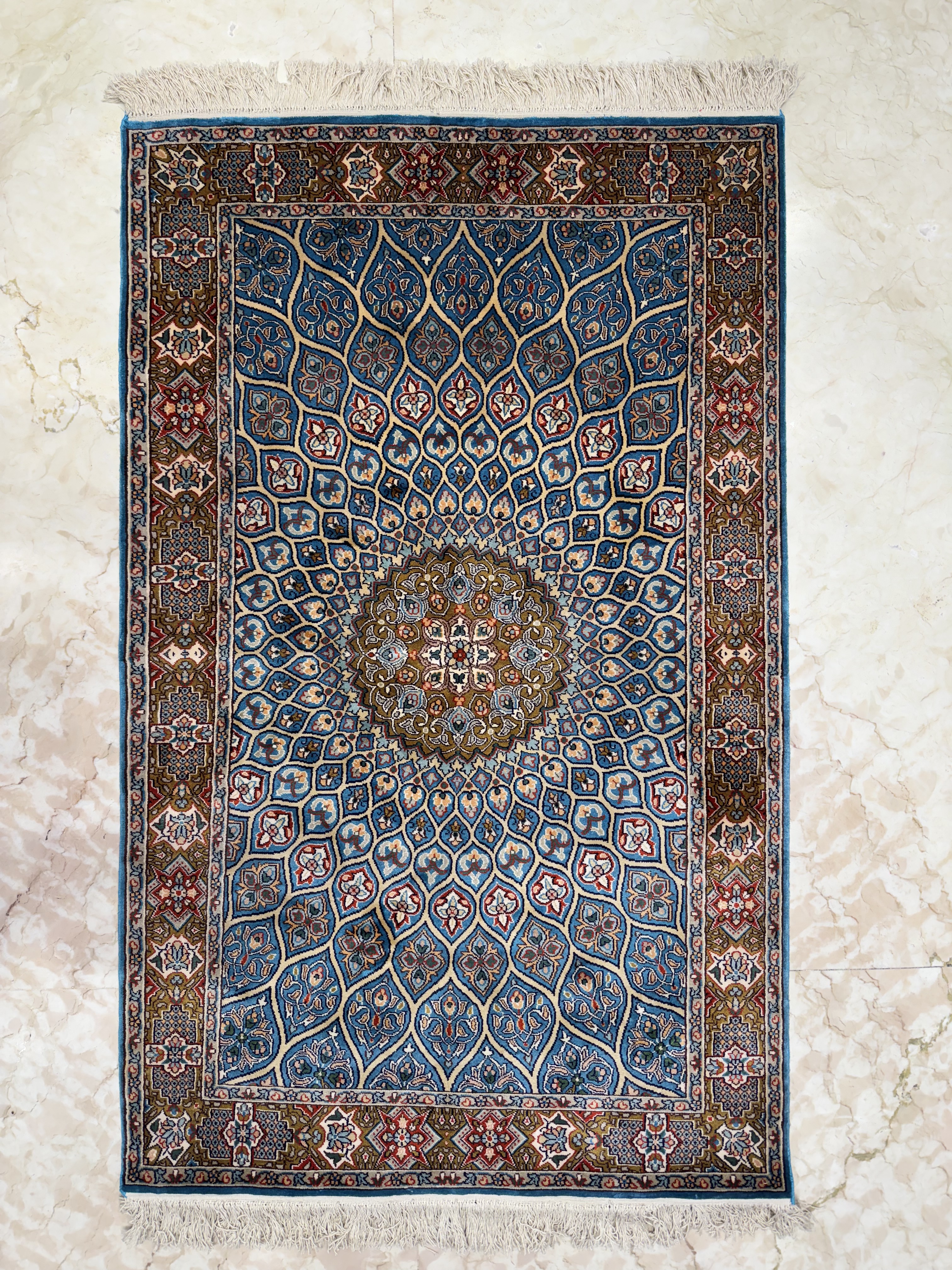
Depending on the location and the activities, we may or may not have an afternoon excursion. For example, the hike to the Tiger’s Nest in Bhutan was an all-day affair; even though we made good time and got back early, there were no other activities scheduled that day. But in India, we opted for the sunrise at the Taj Mahal, and later that day, we chose to visit some marble inlay and textile merchants. It’s a story I won’t detail here (you can always ask me) but we did end up purchasing a small rug in India. No, we weren’t in the market for a rug, but sometimes, you end up contributing to the local economy because it’s the right thing to do . . . or you get the feeling they won’t let you leave unless you do. No regrets.
Stay tuned for Part 3
 labuznik
Leave a comment